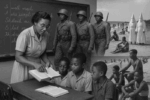
 A world apart yet alive within itself—Black teachers, soldiers, and families finding grace behind the veil of segregation.
In 1940s Tampa, everyone knew where the city stopped. No sign said colored or white, but the streets did the talking. Officially sanctioned city boundaries drew invisible lines through neighborhoods and hearts. Yet within those limits, my parents’ generation built a world of order, dignity, and grace—a parallel universe sustained by teachers, churches, and determination.
I offer this essay not to minimize the cruelty of segregation, but to honor the generation that made meaning inside its walls. My parents were born at the dawn of the twentieth century—children of Reconstruction, grandchildren of slavery. They came of age in a country that denied them equality but not purpose. From that paradox, they forged a culture of excellence that carried their children, and eventually the nation, toward freedom.
We lived, as W. E. B. Du Bois wrote, “behind the veil.” But behind it, life thrived. Teachers ruled classrooms with quiet authority. Neighbors looked after one another’s children. Churches were more than places of worship; they were centers of strategy, music, and mutual aid. Within this “splendid isolation,” we learned to measure success not by comparison to others but by how much we could build from what little we were given.
The separation was unjust, yet the community it produced was whole. My childhood world, though hemmed in by law, overflowed with moral order. It was a world where a teacher’s advice could steady a child’s life and where education was not merely encouraged but demanded. Books became passports to the larger world we were told we could not enter.
Tampa was no exception. Across America, similar communities rose in the shadow of exclusion—Durham’s Hayti district, Chicago’s Bronzeville, and most famously, Tulsa’s Greenwood, the so-called “Black Wall Street.” Each was a testament to what Black enterprise and discipline could create when forced to turn inward. Even after Tulsa was burned in 1921, its example endured: proof that prosperity and self-governance were possible, even behind the veil.
The price of that isolation was steep. Professional doors were closed; ambitions were narrowed by custom and decree. But within the confines of segregation, my parents’ generation built an ethos that valued knowledge as the truest freedom. Teachers and principals stood at the moral center of Black America. They commanded respect not through wealth or title but through education, integrity, and devotion to community. In a world designed to say “no,” their classrooms were training grounds for “yes.”
Then came the war. Thousands of Black men and women, my dad and uncle among them, donned uniforms and sailed to Europe or the Pacific to fight tyranny abroad. They fought for a freedom they did not yet fully possess at home, and when they returned, they carried a restless clarity: the democracy they had defended across an ocean had to be made real here too. The GI Bill, though unevenly administered, offered a small breach in the wall. Some managed to seize its promise—to go to college, to buy homes, to raise children who expected more.
It was those children—the ones born into the ordered world of segregation yet schooled by its contradictions—who would later march in Selma and sit at Greensboro lunch counters. The Civil Rights Movement did not begin on television; it began decades earlier in segregated classrooms where discipline and faith were daily lessons. The courage of the 1960s was cultivated by the patience of the 1940s.
My parents’ generation did not call themselves revolutionaries. They called themselves teachers, preachers, nurses, postal workers. Yet their quiet insistence on excellence formed the moral infrastructure of the freedom movement. When Dr. King preached from the steps of the Lincoln Memorial, he was echoing lessons first spoken in modest sanctuaries and one-room schoolhouses built by people who had refused despair.
To call their world “splendid” is not to romanticize segregation but to recognize the beauty that bloomed in spite of it. Isolation, chosen or imposed, can breed either despair or determination. My parents’ generation chose the latter. They proved that a community deprived of power can still cultivate it from within—that dignity, once learned, cannot easily be stripped away.
Today, as school boards ban books and politicians redraw boundaries once thought erased, I think of that generation. They knew the power of education to defend democracy and the danger of ignorance to destroy it. They knew that progress is neither inevitable nor permanent. Their “splendid isolation” was not a retreat but a rehearsal for freedom.
To grow up behind the veil was to see two Americas at once: the one that was, and the one that could be. The children of that unsung generation—those who integrated universities, challenged unjust laws, and later led classrooms themselves—carried forward their parents’ quiet conviction that truth and talent would, in time, open every door.
Now, as new walls of fear and resentment rise, we might remember the lessons of those who lived behind the old ones. They endured separation without surrender. They cultivated excellence in the face of exclusion. And by doing so, they taught the rest of America how freedom is won—not all at once, but generation by generation.
Their story is not simply one of survival; it is a story of creation. In their “splendid isolation,” they built the moral architecture of modern democracy. We are still standing inside it.