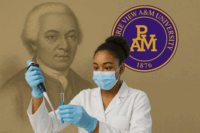
 The Benjamin Banneker Honors College was established at Prairie View A&M University in 1984.
At a time when science is being devalued and expertise questioned, and when programs advancing diversity are under attack, the story of Dr. Kizzmekia Corbett stands out. As an NIH scientist, she helped develop the mRNA vaccine that saved millions during the coronavirus pandemic. Her achievement, however, did not begin in the laboratory. She is a proud graduate of the Meyerhoff Scholars Program at the University of Maryland, Baltimore County—the groundbreaking initiative led by Dr. Freeman A. Hrabowski III that has become one of the nation’s most successful engines for producing Black scientists and engineers. Her success reflects a belief shared by many of us who came before her: that America’s future depends on discovering and developing the genius too long overlooked.
Years before Meyerhoff took shape, we attempted a similar experiment at Prairie View A&M University through the creation of the Benjamin Banneker Honors College. Under President Percy A. Pierre, Prairie View set out to prove that young African Americans could thrive in the nation’s most demanding scientific and technical fields. As founding dean, I recruited a core faculty to design and teach an honors curriculum in the liberal arts, paralleling requirements in general education, that matched any in the country.
Our cornerstone course, “Modes of Thought: A History of the World,” traced global systems of knowledge—mathematics, astronomy, engineering, and philosophy—to show that science belonged to all civilizations. Evening seminars in African American history and culture grounded identity as firmly as intellect. Every Banneker student completed honors courses within their major, emphasizing research, experimentation, and analysis. We strengthened biology, chemistry, physics, mathematics, computer science, and engineering, while encouraging work in public health and economics. To widen opportunity, we forged partnerships with several Big Ten universities, guaranteeing our best students admission to graduate and professional schools. Our goal was simple: turn potential into power and prove that excellence in science is never a matter of race, only of access.
Results came quickly. A National Association of Honors Programs (NAHP) review praised Banneker as “an exemplary model of honors education and a national asset.” Soon afterward, Elaine P. Adams, writing in The Journal of Negro Education (1990), confirmed that our graduates were entering leading research institutions and earning advanced degrees—especially in STEM. She called the Banneker program a “gateway to scientific and technical doctorates.” We had built a genuine pipeline long before the term became fashionable, demonstrating that when high standards meet high expectations, brilliance thrives. Talent is abundant; opportunity is not.
Despite its success, the Benjamin Banneker Honors College was eventually suspended amid financial pressures. Yet its lesson is more urgent than ever. America cannot afford to waste its intellectual capital. Every unrecognized mind is a lost discovery, a cure delayed, an innovation unrealized. When I see Dr. Corbett’s achievements, I think of the promise we made decades ago—to prepare students not just for survival but for discovery. The Banneker College proved that investing in overlooked brilliance is not charity; it is national strategy.
Benjamin Banneker, the mathematician and astronomer for whom our college was named, once challenged Thomas Jefferson to reconcile liberty with slavery. The college that bore his name posed a similar challenge to American education: to reconcile opportunity with excellence and to ensure that no mind, once awakened, is left unused.
Bibliography
-
Adams, Elaine P. (1990). Benjamin Banneker Honors College: Gateway to Scientific and Technical Doctorates. The Journal of Negro Education, 59 (3), 449–462.
-
National Association of Honors Programs (NAHP). c. 1986. Special Committee Report to the Dean, Benjamin Banneker Honors College, Prairie View A&M University.